

Tata (for now)
The delicate tension between oversight and trust-based ownership



The world’s largest social enterprise is fighting for control of its future.
Last week the Reserve Bank of India (RBI) issued new guidance on which companies were large enough that they needed to be publicly listed. Tata Sons, the holding company of Tata Group, was on that list (although it is contesting that status). A Tata listing would be a victory for minority shareholders, and perhaps for corporate transparency. But for a 158-year old conglomerate that prides itself on long-termism and philanthropy, a shift to public ownership is viewed as an existential threat. And for those of us who want to see more purpose-built companies, this struggle raises real questions about the blending of private money and public purpose.
Let’s back up. The Tata Group is a conglomerate with holdings in over 100 subsidiary companies. 26 of them are publicly listed, with a market cap over $325 billion. Those subsidiaries include Tata Steel, Air India, and TCS. They own brands like Jaguar and, most important to me, Eight O’Clock Coffee. Ownership stakes in the subsidiaries are held by Tata Sons, the holding company. And Tata Sons is 66% owned by Tata Trusts, the largest foundation in India. They granted out almost $190M last year, funding medical research, hospitals, universities, scholarships, endowments, the whole gamut.
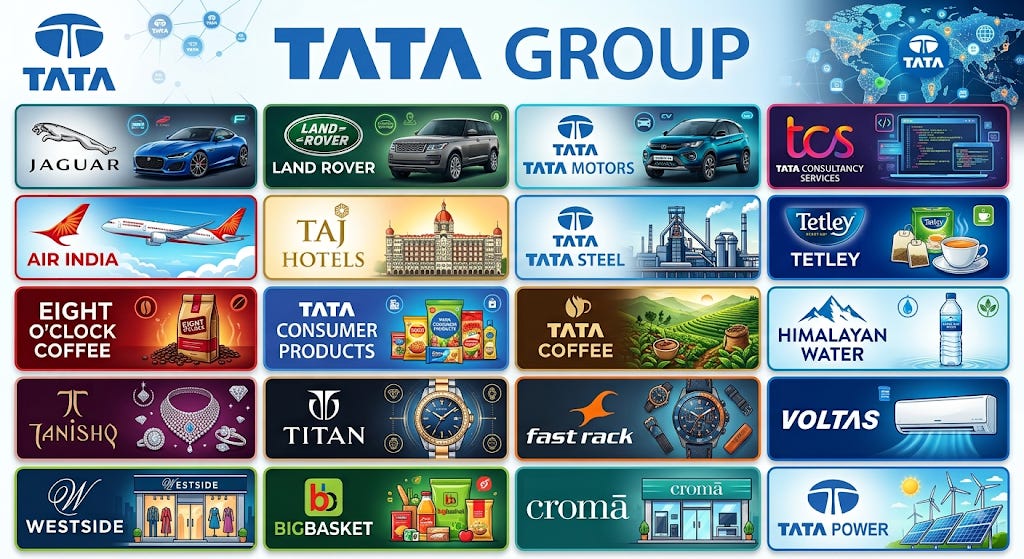
The way the org is structured, profits from the various subsidiaries ($3.7 billion last year!) flow up to the holding company, then are retained or paid out to the Tata Trusts as dividends. The various Tata Trusts then use those dividends to fund various noble things. The Trusts also nominate multiple board directors to Tata Sons, with sufficient votes that those directors dictate the agenda of the board. If that sounds to you like an insular way to run one of the world’s largest companies…well, you’re not the only one.
Two issues are coming up. The more straightforward one is the RBI. Systemically important institutions (defined by asset size) require greater oversight, and boy oh boy does Tata Sons qualify, although they’re trying to get under the threshold. The RBI’s tools for oversight include public listing and related disclosures. Tata Sons became a private company in 2017 (there were lawyers), specifically to control who could buy/sell its shares, and who had a say in major decisions. The chairman of Tata Trusts has written to the RBI, arguing that a public listing would disrupt their ability to allocate patient capital over a decades-long timeframe.
The second, even messier issue is minority ownership. 18% of Tata Sons is owned by another family, the Shapoorji Pallonji group, with historic ties to the Tata family that have frayed spectacularly in recent years. SP’s other holdings are now in decline, and they want to sell their shares in Tata Sons. But they can’t! The private, trust-owned nature of Tata Sons means that the Trusts get right of first refusal on any sale. So an IPO would be a lifeline for SP group, and they, along with some directors within Tata, are pushing hard for it. But others are convinced that quarterly reporting and liquid minority ownership will dilute Tata’s purpose: philanthropy.
Why should you care? Because trust-based ownership is supposed to be the kinder, more sustainable alternative to public shareholder governance. But the Tata case shows that the insularity comes at a cost of accountability.
In theory trust-based ownership allows for longer-term thinking and sustained value creation. Instead of anonymous, rapacious capitalists, you get cooler heads with a longer-term focus. If you’ve ever been to a shareholder meeting, that sounds like a good tradeoff. But trusts are run by people, and people are fallible. The same structure that allows Tata to ignore short-term market sentiments also allows it to ignore shareholders that might have a legitimate point. Within a public company, there are levers to pull when you think a company is being mismanaged. Within a trust-owned company, not so much.
This tension is not unique to Tata. OpenAI was a nonprofit led by an explicitly mission-focused board, but when they tried to fire Sam Altman in order to preserve that mission, the money won. Sam Altman is the CEO today, and those board directors are gone.
Anytime a mission-driven enterprise sells a part of itself to investors who are not similarly mission-driven, the potential for conflict exists. What if you don’t agree with how the company is pursuing its mission? What if they are pouring money into massive, loss-making ventures? Outside of making your case in private and to the press, there’s nothing you can do about it. And maybe that is exactly as it should be.
I hope there are more fights like this. Win or lose they’ll set the precedents, written and unwritten, that determine whether purpose and public capital can actually coexist.
Other things we’re reading

Staying in India, the India Development Review had a flamethrower of a post on the silence of nonprofits during the recent Cockroach Janta protests. I loved this line: “We are quick to demand that others step up, that others show courage, that others fight entrenched systems that could break them and take their lives. And yet, what are we doing?” The counter argument is that remaining quiet is sometimes necessary for the continued survival of a given org, and there’s an assumption in there that long-term survival of a given nonprofit is worth its silence. But IDR takes issue with that argument, challenging whether the world really needs nonprofits at any cost.
Pioneer Post has a great article from Impact Investing Ghana and Savannah Advisory about the first close of their new $75m Ci-Gaba Fund, which is an open-ended, local currency vehicle funded by Ghanaian pensions, and underpinned by catalytic capital from Small Foundation and FSD Africa. Their core thesis was that African pensions don’t support impact vehicles because they are not designed for their needs. By taking that as a first design principle, they were able to build something that would attract local capital.
Lastly, Jasmine Sun has been getting deserved publicity for her recent newsletter on the furious pushback to data center construction in rural America. Some of this is old news made fresh: rural communities bearing the burden of urban infrastructure is a defining tension of modern life. But I think Jasmine gets to the real heart of the issue: this is about AI, and about people feeling an increasing lack of control over the future of their lives, their communities, and their country. It featured this memorable quote from the Democratic Senate candidate Abdul El-Sayed: “It’s the end game of the worst excesses of tech generally: to sell us s*** we don’t need, but that a few very, very powerful people have decided can make money.”
On my mind with Nikhita Nadkarni
This week I am beyond thrilled to have three questions with Nikhita Nadkarni, the Head of Programs and Partnerships at Acumen India, with whom I once had the pleasure of running a focus group in the middle of a Mumbai recycling center.

You have spent the last several years focused on investments in the waste management sector, trying to improve environmental and human outcomes. Has that changed your personal approach to waste and the people who handle it?
The biggest shift for me is that I just don’t think about waste in the same way anymore. I’ve become much more conscious of what I’m buying/consuming and what I’m throwing away. It’s the little things.. I actually find it quite criminal now to buy a PET water bottle or blow up a bunch of balloons for my daughter’s birthday. Even the sheer amount of packaging that comes with an online order makes me think when I really needed all that this. I’ve begun to reduce/eliminate as much of that as I can. At home, I’ve become a bit obsessive about segregation and I find myself wanting to know what actually happens after the waste leaves the house and is it actually disposing of it responsibly? But I think the bigger change has been in how I think about the people who handle our waste. Collectors, sweepers, segregators – I just realise how invisible these workers are and how much we depend on them without really acknowledging them.
As part of that work, you’ve looked at a number of companies who are unlocking value from waste. What are some of the most fun or exciting innovations you have seen?
We’re invested in 3 companies and there’s honestly so much exciting work happening across the ecosystem. A few things that immediately come to mind:
Small robots that can sort waste (still in the early pilot stages) but could be a game changer for dignity/efficiency
Of course there’s Bintix (waste data to generate consumer insights), Without / Ashaya (using MLP into really cool products such as sunglasses), and Bare Necessities (refillable deodorants)
What probably what excites me the most is converting low-quality MLP (think chips/crisps bags) into packaging and construction materials. The economics and price points aren’t quite there yet, but once this can be done at commercial scale/ right cost, I genuinely think it could replace a significant amount of virgin material.
Both at Acumen and in your prior life at Social Alpha, you’ve been focused on solutions for entrepreneurs at the beginning of their journey. Why are you drawn to that kind of work?
Hmmm. I think it comes down to being part of, and hopefully being able to influence, the trajectory of a company when the decisions being made can really shape what it will eventually become. I love the energy at that stage and honestly the satisfaction when something finally works. Get to be part of that messy, formative stage and help/work with a great entrepreneur go from an idea that works to a model that can scale. There’s just something really exciting about being able to make a difference when it can actually change the course of things.
Listening Corner
As someone who always feels there’s a better version of me trapped somewhere inside, held hostage by by self-sabotage and ice cream, I have been loving the title track on The Beths’ 2025 album “Straight Line was a Lie”.
The song is not complicated (unlike its subject). It’s the chorus played twice through, with this line at the core of it:
“I thought I was getting better
but I’m back to where I started
And the straight line was a circle
Yeah, the straight line was a lie”
 | A guest post by
|
A concise overview of the situation - was thinking of the OpenAI parallel, glad you mentioned that!