

When Everything Matters, Nothing Moves


In Ezra Klein and Derek Thompson’s book ‘Abundance’, they lay out the delicious but frustrating ‘everything bagel’ problem confounding American liberals’ attempts to build nice things. The bagel in question is not one you’ll find at a New York deli, but the torus that threatens all of existence in the movie ‘Everything, Everywhere, All at Once’.

Klein and Thompson’s point is right there in that title: trying to right every structural wrong within discrete projects has created a system in which public projects arrive decades late and over-budget.
The example they use is California’s High Speed Rail. Approved by voters in 2008, the system was meant to connect SF and LA by 2020. Almost two decades later, no one has ridden this train. The project timeline has doubled, the budget has tripled, and all we can expect by 2033 is 171 miles of rail - about a fifth of the way from the Golden Gate to Venice Beach.
How did this happen? Klein and Thompson showed how project managers tried to:
Prevent any environmental degradation through an extra-inclusive review and comment process
Address worker pay through the exclusive use of union labor
Make the project locally inclusive by adhering to the zoning and permitting laws of every township and municipality that the train passes through, without eminent domain
Planners were trying to do more than connect a region; they were trying to change everything about the way that big things get built. But nothing moved.
Impact investing has an everything bagel problem
Impact investing contains a similar tension. Impact funders want to grow good companies solving important problems. Unfortunately, the world is full of important problems. So the apex funders (DFIs, corporate foundations) operate across multiple countries and sectors, and work through dozens (if not hundreds) of intermediaries. They are investing in cocoa in Ghana, plastic waste in India, entrepreneurship in Bolivia, and so on. Each of those problems has its own context and risks, and collectively those dwarf the expertise and judgement of any one institution - better to use intermediaries, with their localized knowledge.
But now what is happening on the ground is out of your control, and likely beyond your understanding. And yet the risks still come back to the funder. If, for example, a carbon project developer is found to be making untraced cash payments to local power brokers, there could be huge reputational damage to the institution and you, the human who made a decision to fund this mistake.
The easiest way to solve this principal-agent problem is to combat macro exposures with micro compliance. Larger and larger teams - legal, ESG, risk, compliance - start requesting more and more paper: gender action plans, environmental and social management systems, child labor policies, forced labor exclusions, end-of-life management plans. Everything, everywhere, all at once.
And again, each of these goals are not just good - they are vital! But when we layer those expectations - and lest we forget, the reporting obligations that come with them - onto an early-stage company or the funds that invest in them, we make it impossible to run or invest in a real-life business.
When Ideal Economies Meet Real Businesses
The former CEO of an off-grid solar company told me in an interview about how his company had, simultaneously, received pressure from its investors to:
Verify that their supply chain had no forced labor in it;
Come up with end-of-life solutions for batteries in a region where not a single recycling facility existed;
Reach poorer households; and
Become reliably profitable
For example, the company was asked to plan and budget for end-of-life battery recycling in a way that American firms, with a vastly more developed infrastructure, still are not today.
More generally, he was frustrated with the idea that his relatively tiny company should be expected to address giant political and economic issues beyond his control. In his view, by starting a business in one of the toughest markets on earth he was already tackling one massive problem: energy poverty. The rest was beyond his control. One thing he said stuck with me: “the ideal of being part of those solutions was conflicting with any part of being a real business.”
Why Social Enterprises Are Not Development Projects
That conflict, between an ideal economy and a real one, is a tension that will never - probably should never - leave impact investing. Mission-driven companies are for-profit businesses AND social experiments. They are explicitly promising to achieve social goals as well as financial gain, and that brings them under the umbrella of international development. Most of their funding (especially in early years) comes from government agencies or philanthropy, both of which have established structures for measuring and monitoring the impact of development projects.
But social enterprises are NOT development projects; they are for-profit companies selling products or services at a profitable price to a willing buyer. And so those measurement structures fit uneasily on companies that need to operate in difficult markets, manage FX and political risk, keep their costs manageable, cultivate talent, and above all: focus.
The Hidden Tax of Impact Capital
The other piece of administrative creep is the unkillable growth in diligence, in fund-level restrictions and compliance. A side letter from a public or quasi-public LP used to be a dozen pages long; now anything under a hundred is a relief. Tripping even minor wires - a social enterprise failing to implement an Environmental & Social Action Plan, e.g. - carries the threat of funding pauses or clawbacks.
Collectively, this amounts to a tax on socially-minded companies and funds. My colleague Julia Mensink highlighted a case of a social entrepreneur who explicitly preferred to raise capital from commercial investors, because they did not want to handle the extra hassle and cost of impact investors. I see their point: those obligations eat directly into your margins, literally raising the cost of the impactful product you’re trying to produce. And that tax is regressive. A full-time impact reporting team might be manageable for a $100M business, but small companies face an impossible reporting burden, at a time when they should be tightly managing their cash.
Impactful companies operate in risky environments filled with uncertainty. Requiring those firms to be compliant with a long and growing list of requirements may feel like the risks have been reduced, and probably some have. But 50 years of institutional sociology have shown us that these types of requirements more often create an industry of compliance, without changing the realities of the business.
Revenue Is the First Impact Metric
I’ll say here two things that I have only ever said over drinks:
First, the greatest evidence of impact is when a person in poverty is willing to pay for a product/service. That transaction tells us that the solution has actual value for the people we purport to serve. And assuming the unit economics are sound, it has a pathway to scale: profit.
Consider a company like Ampersand, that sells electric motorcycles to taxi drivers in brutally competitive markets. Those drivers are sophisticated economic actors. If thousands of them are willing to take the risk of parting with their hard-earned cash, that is powerful evidence. Ex ante, it is the strongest signal we have that the company is solving a meaningful problem in a way that customers value.
We still need to understand how a product or service is contributing to solutions (for Ampersand, that’s e-bikes saving emissions and money). But once we’re convinced and the investment is closed, the indicators we as impact investors care most about are:
Revenue growth: the solution is reaching more people
Repeat customers: it is delivering value over time
Free cash flow: there is a pathway to scale.
I’m not saying revenue always equals impact. Credit, third-party payors, subsidies - these can warp that revenue-impact link, and require more diligence. Businesses can change their product mix and their target customer. But we over-index for that risk. I co-wrote a report on Acumen’s failed investments - a tiny fraction of investments succeeded financially but not impactfully.
What is much more common is that we expect a for-profit business to serve everyone, and it turns out they can only serve the customers who can afford a solution. That’s not a moral failing, it’s financial gravity. Expecting otherwise is how we end up treating companies like projects.
What Impact LPs and GPs Should—and Shouldn’t—Expect
The second: our role as impact investors is to help a social enterprise do what it already does, just do more of it. Absent illegal or immoral practices (i.e. it’s not okay to pay bribes just because you run a good school), we should give entrepreneurs a break on all the things they need to solve and track. We should expect them to address the risks that are material to their business model, to be transparent and act in good faith. And then we should expect them to become the largest, most sustainable, version of themselves.
Growing revenue by serving low-income households is difficult and valuable, even if it is not transforming labor markets or shifting cultural norms. We cannot expect farmers to sit on boards, or for companies to become policy laboratories. Our baseline expectations need to shift from expecting (for example) a mini-grid operator to solve for power and jobs, or power and migration, or power and child labor. If we fund them to solve for power, and we’re VERY lucky and work VERY hard, power is what we’ll get.
I agree with Maoz Brown: impact investing should be hard. But it should be hard because finding deals that make the world a better place and are legitimately additive is hard. We should not make life harder for visionary entrepreneurs, we should make it easier. That’s how we get more of them.
Right-Sizing Expectations
Now let’s get practical. First, let’s right-size expectations:
If you’re making less than $1M in revenues operating in an emerging market, then LP and GP focus ought to be on building your capacity, not making you compliant.
If you’re between $1M and $10M, you should have systems in place to mitigate the second and third-order issues created by your model.
Bigger than that, you should be fully compliant (and also maybe talking with other large social enterprises about how to streamline and standardize reporting).
FMO has been a great example of this in our portfolio: in earlier-stage agri-businesses, they have adjusted their risk management to a capacity-building approach. Acumen flags the areas of weakness in a potential investee, but barring severe red flags, these are marked as conditions to be addressed subsequent to our investment. For smaller companies, this is a great way to approach legitimate social and environmental risks.
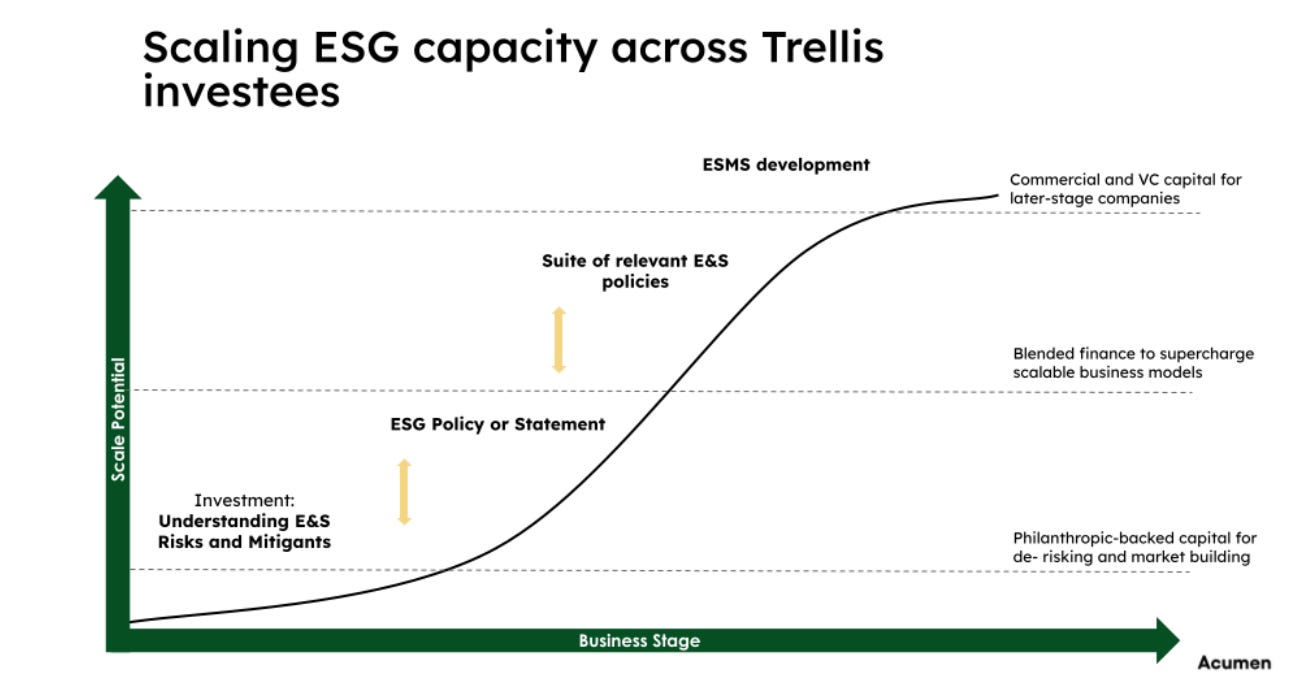
Second, let’s add value to the business, instead of detracting it. The CEO I mentioned above was deeply proud of the work his company had done on gender. It was something they felt strongly about, that was clearly linked to their mission, and that had positive ROI. Investors provided valuable TA to enable that work.
Impact investing at its best
Back to the bagel. Klein and Thompson argue that what we need is less ‘legitimacy of process’, which inherently favors inaction over action. Instead, we need to “fall back in love with outcomes”. Take the high-speed rail example. Over the same period that California built 171 miles of rail (2008-2024), China built 24,000 miles; enough to ride around the world.
The comparison with China is both uncomfortable and revealing. The legitimacy of the Chinese government is not derived from stakeholder inclusion, but from an inexorable focus on delivering better outcomes for most people. The New York Times had an article last year on a village underneath the highest-voltage power line in the world. People talked about sparks shooting off of umbrellas and shocks when they held metal fishing rods, but few “dare object”. Yet that same line is powering a green revolution by connecting vast solar arrays in the northwest with huge EV factories in the southeast.
Marc Dunkelman, author of the book ‘Why Nothing Works’, said recently that “[liberals] have a fantasy, and we’ve had it now for several decades, that if you get everybody in the room early enough in a planning process, you can create a product or an outcome that has no trade-offs.” We may not love a decision that leads to a pond having a warning label about electrified fish. That trade-off is real. But these are the kind of difficult decisions that, made over and over, reduced China’s poverty rate from 58% in 1999 to 0% today. That kind of success breeds legitimacy: 6 out of 7 Chinese respondents in the Edelman Trust Barometer say they have confidence in their government to do the right thing, the 2nd highest in the world.
Impact investors are obsessed with how we can grow our tent. The answer is not through omni-compliance or a fantasy of zero tradeoffs. The answer is through ambition, achievement, and outcomes. Social entrepreneurs want their companies to be great. Good investors help them to focus on the problem they’re trying to solve. Ultimately we will all be judged, not by the risks we mitigated, but by what our capital delivered for the people we purport to serve.
 | A guest post by
|